
Part 1 | Why is Japan's IT investment not leading to results? - The structural issues that prevent Japanese companies from breaking away from "defensive IT" -
Why don't companies change even though they invest in IT?
"We are investing in IT."
"The system has been replaced."
"Work efficiency has improved somewhat."
nevertheless--
Sales are not increasing and customer relationships are not changing.
Many Japanese companies feel this sense of discomfort.
In fact, this problem isIt's not a question of IT performance or budget.
The cause lies deeper.
This is because much of Japan's IT investment
"It remains "IT for protection"The fact is.
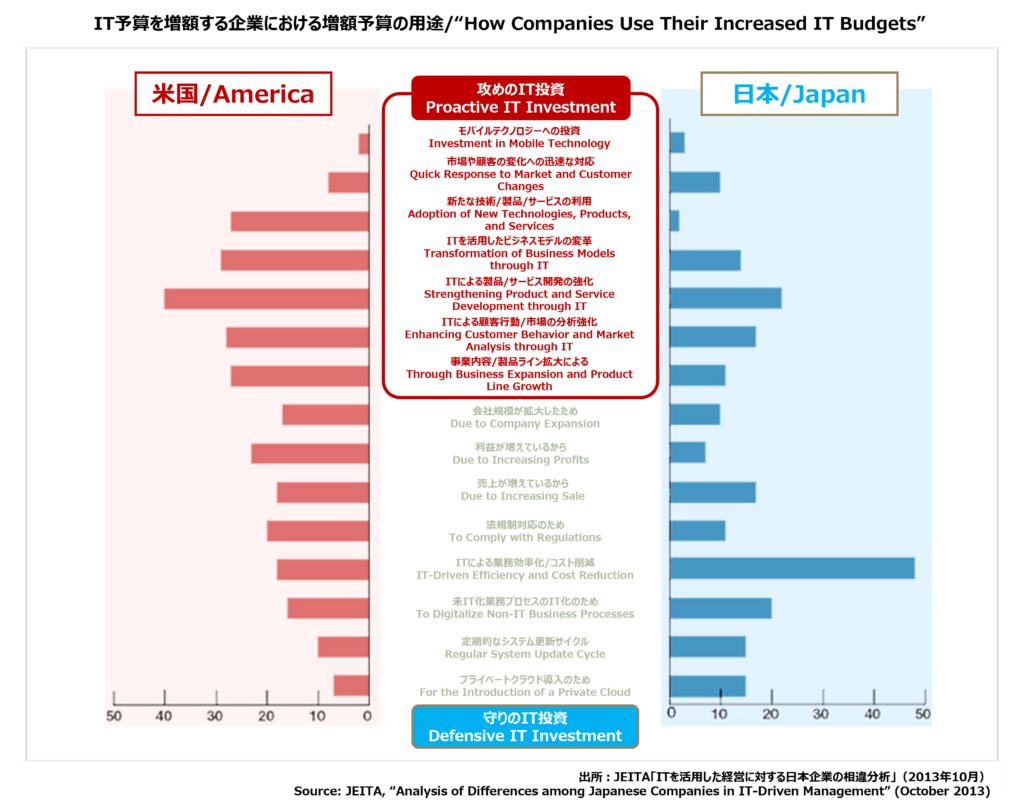
◆Japan's IT investments are centered on "defense"
The majority of IT investments by Japanese companies
- ▶Improved business efficiency
- ▶Cost reduction
- ▶ Addressing labor shortages
- ▶Systematization of existing business
This is , so to speak, a "defensive IT investment . "
These are certainly important.
However, this alone is not enough for companiesDoesn't grow.
Meanwhile, in American companies,
- ▶Creating customer experiences
- ▶Developing new services and markets
- ▶Data-driven decision-making
- ▶Transforming the business model itself
Such proactive IT investments are commonplace.
This difference manifests itself as a difference in the speed at which companies grow.
◆The way IT talent is used is fundamentally different
There is another structural difference that cannot be overlooked.
There are approximately 100 million IT engineers in Japan.
This is only about one-third of the rate in the United States.
Even more crucial is the
- ▶Japan: Many IT professionals IT company side
- ▶US: Many IT professionals IT users (business companies)
That is, in Japan,
How to use IT to transform your business
There are very few people in companies who think about this.
As a result,
- ▶IT is a "tool for on-site improvement"
- ▶Separate from business strategy
It has become like this.
◆ "Incorporating IT" does not equal "DX"
In Japan,
- ▶ Core system renewal
- ▶Cloud
- ▶RPA implementation
Measures such as these are called "DX."
However, the true meaning of DX is
ITChanging the way companies create value
.
Just by making the work a little faster,
The value to the customer remains almost the same.
Customers evaluate
- ▶Do they understand me?
- ▶ Will they make suggestions that suit me?
- Do you want to continue working with this company?
That's the kind of "relationship" it is.
What IT investments are currently required of Japanese companies?
The question of future IT investments is,
How deeply do you understand your customers?
.
To overcome this, there's a teaching called
- ▶Customer information is not fragmented within the company
- ▶Interactions with customers are accumulated as assets
- ▶ Ability to think about strategies based on data
becomes essential.
Here for the first time,
CRM (Customer Relationship Management) begins to take on significant meaning.
◆Next episode preview | What is “aggressive IT investment”?
next time,
Gartner proposed
"Bimodal IT" Starting from this,
- ▶The difference between defensive IT and offensive IT
- ▶Why Japanese companies can't move to Mode 2
- ▶The IT investment approach that growing companies are always taking
We will explain this in an easy-to-understand manner.
Click here for Arcus Japan Co., Ltd. CRM⇩
Arcus Japan CRM - Arcus Japan Inc. - A leading CRM company and IT consulting firm
Person who wrote this article

Articles in the same category
-
CRM Usage Guide for NPOs and Nonprofit Organizations — Members, Donors, etc. […] -
CRM Usage Guide for Advertising Agencies — Centralizing Clients and Projects […] -
A CRM Usage Guide for Travel Agencies — Using travel history and preferences to make the next proposal […] -
How to interpret the breakdown of CRM initial costs — How to avoid mistakes in quotes […] -
Differences between CRM 4.0 and personalization -
How to utilize customer data in the AI era — "Quality over quantity" is more important than ever before […]